|
Insights regarding the work of identifying and eliminating unquestioned false beliefs and unifying the best of modern science and ancient wisdom.
This is to help derive a firm foundation for a unified science upon which the new cycle of civilisation can make its stand.
It also offers a systemic perspective on the nature of various phenomena in the world from consciousness to economics to the global paradigm shift that is currently under way and more.
See the main website at www.anandavala.info for more detailed information.
Contact me via facebook or email.
Unique Readers:
Syndication:
 ![[Valid RSS]](/pic/valid-rss.png "Validate my RSS feed")
Anandavala website
Related Links
Sites:
NCN
NCN Newslogs
|
|
|
2010-07-08
I am not very familiar with the "Integral
Theory" memeplex, however I have begun to observe and
contemplate it. In particular my mind is contemplating the
epistemological issue of...
How do Integral theory and naïve
realism relate?
This question can be disected into two questions:
How does Integral theory recognise (i.e. understand,
describe, represent and assimilate) the phenomenon of naïve
realism, either directly or indirectly via related phenomena?
How is Integral theory influenced at an epistemological level
by naïve realism?
If anyone has any comments,
links etc regarding these questions and potential answers, then
please let me know via facebook
or twitter or email.
Regarding the second question,
The following quote from "An
approach to critiques of integral theory" points to an area
in which the influence of naïve realism may potentially be found
within integral theory. More >
|
|
|
|
2010-07-08
@notthisbody how do memetic algorithms relate 2
collectiveIntelligence?
Related questions are, What is a meme, memeplex,
mind, collectiveMind?
A meme is a cognitive virus that breeds via repetition.
Symbolic expressions are its outer form & ideas, beliefs, etc
are its inner form.
A memeplex is an integrated self-reinforcing network of
memes, for example 'modernism' & 'Hinduism' are two memeplexes.
A mind is a memetic ecosystem where memes & memeplexes
compete for dominance. The ego / personality is the 'mainstream'
memeplex.
When minds communicate they interlink & form a
multidimensional socioCognitive landscape - a larger memetic
ecosystem - a collectiveMind.
When the ideas that we think come filtered through our
socialNetworks we are experiencing reality through the lens of the
collectiveMind.
When we share ideas with others we are contributing to the
reality experienced by the collectiveMind.
Culture is collectiveIntelligence in action.
More tweets from @anandavala at http://twitter.com/anandavala
|
|
|
|
2010-07-04
- One does not become enlightened by imagining figures of light, but by making the darkness conscious (CarlJung)
- Our present ego-feeling is a shrunken residue of a much more inclusive all-embracing-feeling, a more intimate bond (Freud)
- Freud gave us insight/demonstration that the ordinary person is a shrivelled desiccated fragment of what a person can be (RDLaing)
- For man has closed himself up, 'till he sees all things thro' the chinks of his cavern (WilliamBlake)
- The 'I' that I think I am is a self image formed in the mind. I am not what I think I am. So what am I? That is THE question!
- When a thought is born you are born. You think there's 'somebody' who feels your feelings; that's the illusion. (UGKrishnamurti)
- Nothing keeps you from liberation except fear. You are afraid of being impersonal, of impersonal being. (Nisargadatta)
- That which is the subtle essence, in it is the self of all that exists. It is the True. It is the Self & thou art it. (Chandogya Upanishad)
- Imagine ur a sentient being within a VR, it would seem physical, you would seem separate, yet the true agent behind every action is the CPU.
- In this VR scenario computation "is the self of all that exists. It is the True. It is the Self & thou art it. (Chandogya Upanishad)
- RT @petervan Virtual Reality you can reach out and touch http://bit.ly/cJS08I When virtual reality feels real http://bit.ly/dtTvxA
- In tech VR we look from the outside in but in cosmic VR we are emergent from the information process, which animates every thought/action.
- Quantum Mechanics also provides an information theoretic analogy for the nature of reality
- The "physical universe" is analogous to a VR animated by "universal consciousness" and it evolves as a unified holistic process.
- Hence - events happen, deeds are done but there is no individual doer of any deed (Buddha)
- The objects we experience are objects-of-perception; the contents of awareness that are imagined to exist "out there" due to naive realism
- Hence - "with our thoughts we make the world" (Buddha)
- Signs of an emerging paradigmShift http://bit.ly/dfxL4R : quantum mechanics categorically proves naive realism is a false perspective.
- For details of QM disproof of naive realism search for "Stern Gerlach" http://bit.ly/cCOjTx or see relevant chapter of http://bit.ly/9XhElB
More tweets from @anandavala at http://twitter.com/anandavala
|
|
|
|
2009-11-11
Personality
In general a personality can be described as an integrated set of
modes of behaviour through which a system interacts with an
environment. Each system has a range of potential behaviours and a
set of stimuli / response associations. A stream of particular
behaviours arises in response to a stream of events, which are part
of an experiential interaction with some environment. Within this
stream of behaviours and associations there are patterns and this set
of patterns can collectively be called the generalised personality of
the system. Different 'modes' of behaviour correspond to different
sub-personalities.
Ego
The ego is a point of identification. It is a simulacrum of the
system symbolically represented within a complex system's stream of
consciousness. It functions as a point of self-reference and
self-control.
Ego + Personality More >
|
|
|
|

2009-09-30
.
|
|
|
|
2009-09-30
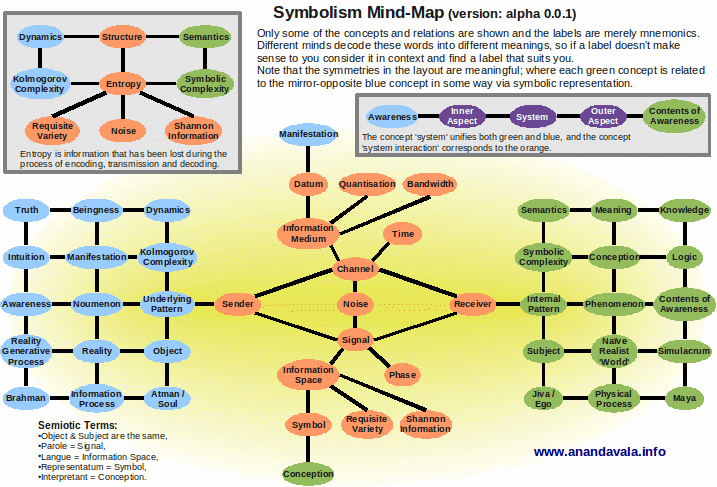
Notes from a brainstorm about symbolism and its
place in the broader context.
Firstly a mind-map that gives a high-level overview of the context
in which these thoughts take place (full size pdf), and then some brief notes.
More >
|
|
|
|
2009-09-22
First a few words about the work and then some links.
In brief, in 2000 I intuitively received a vision of the nature of
reality that re-oriented my world-view. Other than a new way of
understanding, it mainly expressed itself in my mind as a form of
mathematics, which I came to understand through the framework of
information and system theory, mystic metaphysics, quantum mechanics
and virtual reality simulation.
This evolved over time into a project that could be described as
"laying down the philosophical, mathematical and theoretical
foundations of a unified holistic science" and "using this
foundation to shed light on and unify both ancient and modern
wisdom". The work also involves self-enquiry; observation of,
and participation in, the evolution of collective consciousness; and
the navigation of a paradigm shift in our collective world-view.
To give some insight... Imagine that this physical universe could
be thought of as a virtual reality simulation, within which we are
evolved sentient virtual beings. It would all seem to us to be
physical and in no way different from how it currently does. In this
analogical context what I address is not the objects, people, places,
events, sights, sounds, shapes, qualities, etc within the VR
universe.
What I describe and model is the computational process, the logic
of the simulator, the simulation process in action, the structure of
the model that is animated, the low-level virtual processes and forms
that arise within the VR, how these integrate and evolve into complex
systems, how the behaviour of these gives rise to the principles of
physics, how some of these complex systems may attain sentience and
enquire into the nature of their situation, how they can most
effectively achieve this, what they will find when they do and how
this whole situation relates to mystic wisdom and what it describes
about reality. I also explore how such an understanding can
positively affect our individual lives and society as a whole.
What these virtual beings eventually realise is that ultimately
they are not physical beings in a physical universe with individual
identities, they are motions of a cosmic whole that is non-dual,
non-physical, non-local, non-temporal, imperceptible, all pervading
and the animating essence of all things.
Furthermore, there is a persistent cognitive habit that causes
them to perceive and experience things from a dualist perspective
(naïve realism). When this is recognised and its dominance over the
mind is overcome, then reality can be apprehended clearly. Although
it is not perceptible to the senses, it can be intuitively
apprehended in no uncertain terms because it is the inner most
essence of our being.
The true nature of the underlying reality, beneath the film of
appearances, is ultimately unknowable, however everything else about
it can be modelled mathematically and understood scientifically once
we go beyond the limitations of naïve realism, thus providing a
solid foundation for a unified holistic science/spirituality.
Here is a general
introduction that paints an overall picture of this line of
research.
A ground up reformulation
of the philosophical foundations underlying the work.
The mathematical
model at the core of the work.
The main essay
describing the world view implied by the results.
The motivation
behind the work.
A high level memetic
map of areas of interest.
Lots of essays
on the main website.
Here are a few articles, although there are hundreds of others... More >
|
|
|
|
 2009-09-13 2009-09-13
Did you know that last month:
Mexico decriminalized possession of small amounts of marijuana,
cocaine, heroin, LSD, methamphetamine and other drugs.
Whilst Argentina's Supreme Court unanimously ruled that it is
unconstitutional to punish an adult for private use of marijuana as
long as it doesn't harm anyone else. Supreme Court Justice Carlos
Fayt told the state-run Telam news agency that "reality"
changed his mind.
Also earlier this year, a Brazilian appeals court ruled that
possession of drugs for personal use is not illegal.
According to Peter Hakim, president of the Inter-American Dialogue
policy institute in Washington, a trend is at work, "It's all
part of a harm-reduction approach," Hakim said, noting that
policymakers are shifting away from getting rid of drugs and toward
figuring out how to reduce harm to users and society. More >
|
|
|
|
 2009-09-01 2009-09-01
Simulacrum: Something that replaces reality with its representation, which is not a territory, a referential being, or a substance. Simulation is the generation by models of a real without origin or reality: a hyperreal. It is not imitation, nor duplication. It is substituting the signs of the real for the real. The simulacrum's function lies in the derealization of the whole surrounding world of everyday reality.
Paraphrased from Definition: Simulacrum.
|
|
|
|
2009-08-28
Extracts from two different Satsangs...
We are nothing. You have no reason to exist. As a matter of fact,
you do not exist. (Laughter) You have never really existed. It is all
a cosmic joke. There is no reason for you to be alive and to be here.
This may sound like an insult – it is! (More laughter) But it is
the truth and the truth hurts.
You may think you are important, that you have come to earth to
accomplish great deeds, or to get enlightened. That is not true. The
enlightenment is already here and it doesn't need you. You are not
wanted by anything or by anybody. (Laughter) You are a complete
failure. (Loud laughter)
In truth you do not exist. The illusion of your existence makes
you think that you are important, that you are somebody. That is why
we talk about being nobody so much; there is no body.
(It's All a Cosmic
Joke, Robert Adams) More >
|
|
|
|
 2009-08-28 2009-08-28
Below are extracts from the Lankavatara
Sutra that are related to naïve realism, information theoretic metaphysics and self-realisation.
All that is seen in the world is devoid of effort and action
because all things in the world are like a dream, or like an image
miraculously projected. This is not comprehended by philosophers and
the ignorant, but those who thus see things, see them truthfully.
Those who see things otherwise walk in discrimination, they cling to
dualism. The world as seen by discrimination is like seeing ones own
image reflected in a mirror, or ones shadow, or the moon reflected in
water, or an echo heard in a valley.
People grasping their own shadows of discrimination become
attached to this thing and that thing and failing to abandon dualism
they go on forever discriminating and thus never attain tranquillity.
By tranquillity is meant Oneness, and Oneness gives birth to the
highest Samadhi which is gained by entering into the realm of Noble
Wisdom that is realisable only within ones inmost consciousness... More >
|
|
|
|
2009-07-03
My good friend Glisten
was recently asked to describe the vision arising from my work in one
sentence; I too gave this some thought.
The work is broad so here are five sentences that address
different aspects:
The allegedly physical universe is a construct of observable
phenomena arising from a cosmic quantum computational process, and
the stream of awareness that witnesses phenomena is a 'thread' of
the cosmic process.
All objects, places and events arise due to the unified
cosmic process experiencing itself as it unfolds according to its
nature; within that broadest context there is no separation and
nothing is by chance.
We are like virtual beings in a virtual reality simulation,
where the world and the self that appear to exist are objects of
perception reflected in memory, whilst the true Self of all manifest
forms is the One Self, which is the unified animating process.
Virtual reality provides a scientific / mathematical /
computational analogy by which to understand the nature of reality;
the cutting edge of modern science is beginning to realise this and
will eventually be able to comprehend the ageless wisdom.
The only obstacle to realising the true nature of ones Self
and the cosmic Whole is naïve
realism, which is a habit that operates at the root of the mind
and distorts each moment of awareness; once this habit is overcome
(by whatever means) awareness of reality shines through.
|
|
|
|
2009-04-25
The distilled essence of my input to a
conversation on the forum of the Society
for Scientific Exploration (SSE), which is still continuing so this will grow.
Within the latest SSE newsletter there is an article called
"Signs
of an Emerging Paradigm Shift", which is about naive
realism. The newsletter can be read at:
http://www.scientificexploration.org/explorer/explorer_22_3.pdf
The relevance of these issues for SSE is that naive realist
assumptions are the foundation of the wall of denial that is
maintained by established science. Thus by overcoming these
assumptions that wall is falling apart. This has profoundly
revolutionary consequences for the whole of civilisation, and SSE
is in a prime position to be at the vanguard of the paradigm
shift if it chooses to be.
Warning: This discussion explores an alternate paradigm
that is radically different from the established paradigm. For
many people the established paradigm is intrinsic to the familiar
world that they have known most of their lives and within which
their ego has found its comfortable and secure niche. So be
warned that this subject matter can elicit an unconscious
irrational ego defence mechanism within your mind. To keep an
open mind one must exercise self-awareness and from this much can
also be learnt.
|
|
|
|
2009-04-12
The individual ego is a self perpetuating thought process within
the mind that identifies with the activity of the mind and the
contents of the mind and assumes that “I did that”. The
collective ego is a ruling regime within a culture that identifies
with the activity of the culture and the contents of the culture and
assumes that “it is responsible and in control”.
In the same way that an individual ego believes that the organism
is “its body” so too does a collective ego identify with the
population. Thus the term 'ego' refers to the general phenomenon,
which may be an individual ego in an organism or a collective ego in
a civilisation.
Ego Defence
Mechanisms are psychological strategies brought into play by
individuals, groups and nations to cope with reality and to maintain
self-image. An ego defence mechanism becomes pathological when its
persistent use leads to maladaptive behaviour such that physical
and/or mental health is adversely affected. The purpose of the Ego
Defence Mechanisms is to protect the ego from anxiety, social
sanctions or to provide a refuge from a situation that it cannot
currently cope with.
Ego Defence Mechanism are pathological when they prevent the
individual or collective from being able to cope with a real threat
and it obscures their ability to perceive reality. Ego defence
mechanisms are basically immature and are commonly used during the
formation of the ego but usually persist throughout the life of the
entity. Use of defence mechanisms prevents optimal coping with
reality and leads to inappropriate behaviour. They are neurotic and
common in almost everyone, and are not optimal for healthy reality
coping and lead to problems with participation in the world thus they
generally result in suffering.
Defence mechanisms are used by the ego to consolidate and maintain
itself. Mental illness is a dysfunctional demonstration of a
pathological maladaptive response to life events. An ego defence
mechanism becomes pathological when: More >
|
|
|
|
2009-04-12
The mind can be used as a tool to clarify the mind. By identifying
and overcoming its own illusions it can perceive and participate in
reality. Aside from the mind and its contents, is there anything else
that truly exists? If all that we have ever experienced is the
contents of the mind, interpreted as personality, body and
world, then a mind-shift can totally and radically change everything.
"The light of any lamp dispels in a moment the darkness of
long kalpas [aeons]; the strong light of the Mind in but a
flash will burn the veil of ignorance... Although the mind is void in
essence, all things it embraces and contains." (Tilopa's
Song of Mahamudra)
"To bring Peace to All, one must first discipline and
control one's own mind" (Buddha)
"Normal consciousness is a state of stupor, in which the
sensibility to the wholly real and responsiveness to the stimuli of
the spirit are reduced. The mystics... endeavour to awake from the
drowsiness and apathy and to regain the state of wakefulness for
their enchanted souls." (Abraham Heschel)
"And we, with our unveiled faces reflecting like mirrors
the glory of the Lord, all grow brighter and brighter as we are
turned into the image that we reflect." (Bible, 2
Corinthians, 3:18)
"I salute the light within your eyes where the whole
universe dwells; for when you are at that center within you, and I am
at that place within me, we shall be One" (Crazy Horse,
Native American Lakota Tribe)
In regards to the issue of dialogue to clarify and liberate
consciousness, which is an exchange of words, the I Ching speaks of
the metaphor of "eating ancient virtue" (note: in
the context of the I Ching 'virtue' means "inner brightness
and connection to reality"). To just intellectualise things
is like chewing food then spitting it out. We need to chew, swallow,
digest and assimilate wisdom so that it nourishes and pervades the
whole mind and cultivates an inner brightness that is illuminated by
the Light of Reality.
Then "the strong light of the Mind in but a flash will
burn the veil of ignorance". To achieve this "one
must first discipline and control one's own mind". Then "the
sensibility to the wholly real and responsiveness to the stimuli of
the spirit" will re-emerge and "with our unveiled
faces reflecting" reality rather than illusion we "all
grow brighter and brighter as we" come to realise and
actualise the Truth that we are. When each mind-stream experiences
itself, the world and each other from this perspective we will all
"salute the light within... where the whole universe
dwells". When we are each "at that center within"
ourselves "we shall be One".
|
|
<< Newer entries Page: 1 2 3 4 5 6 7 8 9 10 Older entries >> |
|
 |
Previous entries
2011-03-13
A system's perspective on open-source social operating systems
2011-03-09
Quantum Mechanics, Decoherence, Observables, Consciousness and Paradigm Shift
2011-03-06
Processual Metaphysics
Defending mind from anti-mind spirituality
Overview of information system metaphysics
2011-03-01
Exploring some patterns in the I Ching
2011-02-25
Decoherence and the Quantum Sentience Paradox
Interesting countup-countdown pattern
2011-01-09
A True Current of Western Spirituality or a Partial Realisation?
2010-12-28
Comments Regarding The Truth
Quotes regarding truth, reality and knowledge
2010-12-27
Shadow Personality and the Poisoning of the Mind
2010-12-16
Purifying one's mind and infowar both personal and global
2010-11-08
Mystic Perspective: Comments and Quotes
2010-11-02
Topics Related to Recent Thoughts
2010-09-30
Self-organising narrative on the nature of reality
2010-07-31
Innovation Yantra
2010-07-22
Is the Universe a Simulation? - My Answer on Quora.com
2010-07-17
Trusting Self-Organisation - TweetList
2010-07-16
About Coherence
What is knowledge and what is to be known?
What is a 'liminal' state?
2010-07-13
What is Consciousness? - My answer on Quora.com
Karma Yoga: The Way of Action - Quotes from the Bhagavad Gita
2010-07-11
Synthesising Whole Systems - CALRESCO
2010-07-10
The Jewel of Immeasurable Worth
Quotes Regarding Gnana, the Yoga of Supreme Knowledge
Quotes regarding the illusion of being a person
2010-07-09
Organisations, Collective Consciousness & Developing Human Potential - TweetList
Simulation Argument and Dualism
Naïve Realism Discussed in the Lankavatara Sutra
2010-07-08
Integral Theory and Naïve Realism
Memes, Minds & Collective Intelligence - Tweet List
2010-07-04
Tweet list re: the nature of reality, self, experience & the world
2009-11-11
Personality and Ego
2009-09-30
Memetic Map of Areas of Interest
Symbolism Brainstorm
2009-09-22
Overview
2009-09-13
A new strategy emerging in the war on drugs.
2009-09-01
Simulacrum Definition
2009-08-28
Liberation is not of the person, but from the person
Extracts from the Lankavatara Sutra
2009-07-03
The vision arising from my work in five sentences
2009-04-25
Discussing the Emerging Paradigm on the SSE Forum
2009-04-12
Ego Defence Mechanisms
Harmony and Oneness through Clarifying Dialogue
2009-04-07
Reclaiming 'Realism' for the Sake of Being Realistic
Biological Analogy for Agents of Change
2009-04-05
Advice on Nurturing the Emerging Memeplex
2009-04-04
Shape of the Emerging Memeplex and How to Nurture It
2009-03-23
Wisdom for this Phase of the Journey
2009-03-21
Descartes, Scepticism, Rationalism, Meditation and Intuition
Update on Recent Work
2009-03-18
What I Think in Simple Terms
2009-01-11
Consciousness, Self, World, Virtual Reality and Liberation
2009-01-09
Signs of a New Paradigm 01
2008-12-04
Profound Metaphysical Questions to Ask Yourself
2008-11-30
The Hard Problem of Conscious Experience
2008-11-10
Recent Work
2008-08-13
Seven Steps To Unified Metaphysical Awareness
More ..
|
| Mon | Tue | Wed | Thu | Fri | Sat | Sun |
|---|
|
1 |
2 |
3 |
4 |
5 |
6 |
| 7 |
8 |
9 |
10 |
11 |
12 |
13 |
| 14 |
15 |
16 |
17 |
18 |
19 |
20 |
| 21 |
22 |
23 |
24 |
25 |
26 |
27 |
| 28 |
29 |
30 |
|
|