|
Insights regarding the work of identifying and eliminating unquestioned false beliefs and unifying the best of modern science and ancient wisdom.
This is to help derive a firm foundation for a unified science upon which the new cycle of civilisation can make its stand.
It also offers a systemic perspective on the nature of various phenomena in the world from consciousness to economics to the global paradigm shift that is currently under way and more.
See the main website at www.anandavala.info for more detailed information.
Contact me via facebook or email.
Unique Readers:
Syndication:
 ![[Valid RSS]](/pic/valid-rss.png "Validate my RSS feed")
Anandavala website
Related Links
Sites:
NCN
NCN Newslogs
|
|
|
 2008-07-28 2008-07-28
Before joining the conversation, please read and accept this
Invitation
to a Conversation.
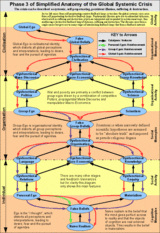
Simplified Anatomy of the
Global
Systemic Crisis and
How to Heal Civilisation
The crisis can be briefly described as systemic,
self-perpetuating, persistent illusion, suffering & destruction.
This analysis describes some salient features of the anatomy of
the global systemic crisis, introducing the anatomy stage by stage
then discussing how best to initiate a process of holistic healing
that can result in lasting peace and creative flourishing.
Brief Summary
Just as life arises from self-perpetuating creative feedback loops
(autocatalytic sets) so too does the global systemic crisis arise
from self-perpetuating destructive feedback loops. Fundamental
illusions give rise to entrenched delusions, which result in
suffering and destruction, which are interpreted and responded to in
delusional ways, thus reinforcing a destructive feedback loop of
delusion, suffering and destruction. The illusions arise from a
single source but give rise to many stages of interlocking feedback
loops that form a feedback network.
In theory it is possible that if any single stage can be totally
healed and kept healthy then this will feed-through the entire
feedback network but in practice this is extremely difficult because
all other stages will seek to undermine the healthy stage or will
compensate to exclude the healthy stage from the network therefore
maintaining the overall destructive feedback network.
To heal the whole feedback network the most effective approach is
to identify many stages where positive influence can effectively be
applied and heal these as much as possible thereby diminishing the
destructive feedback and augmenting the creative feedback. This will
begin a healing process and the situation will change slightly,
whereon we must iterate this again by identifying many stages where
positive influence can be applied and healing these as much as
possible. As this process is applied again and again the whole system
will go through many phases of a healing process that will diminish
the overall destructive feedback and augment to overall creative
feedback. More >
|
|
|
|
2008-07-21
Before joining the conversation, please read and accept this
Invitation
to a Conversation.
Naïve Realism, Empirical Science
and Transcendent Science
Naïve
realism has a tendency to trap our minds within the empirical
world of the senses but we can overcome the cultural effects of this
in a rigorous scientific manner. The main topics covered in this
article are:
Semiotic nature of language and thought,
Overcoming the
limitations of empiricism via abstraction,
Transcendent
conceptual languages,
Transcendent scientific methodology More >
|
|
|
|
2008-07-19
Before joining the conversation, please read and accept this
Invitation
to a Conversation.
The Gaian-Ego Hypothesis
This book was started over a year ago but was put aside, however
now it feels like the right time to finish it off and publish it. It
is mostly finished and will be complete in a couple of weeks. Read it
online at www.anandavala.info/GaianEgo/.
Here is a quote of the brief version of the central idea:
“The ecosystem consists of all organisms including ourselves. It
is the body of a planetary super-organism that some call Gaia and we
organisms are cells within that body, just as organisms are cellular
ecosystems. The large scale ecological dynamics involving climate,
forests, mountain ranges and oceans comprise the overall
physiological processes of that super-organism. The interactions
between individual organisms comprise the detailed biochemical
processes analogous to those between cells within an organism.
However we humans are rather specialised organisms because our
interactions channel information and are therefore analogous to
neurological processes. Our human interactions create society and
culture which give rise to the mind of Gaia. Our informal culture,
composed of individual communication and interaction, is Gaia's
subconscious mind. Our power structures and the public discourse,
composed of legislation, institutions, mass media and academia, are
the conscious mind of Gaia. Mass media, diplomatic channels and
telecommunications are the conduit of conscious thought for Gaia.
The feedback loops between mass communication and individual
communication form the space in which culture resonates and comes to
experience itself. Within this cultural/macro-cognitive scenario a
collective ego has arisen that experiences itself as an individual
being and uses society as “its body”. Just as within human
organisms, which possess a complex self-reflective mind, an ego
arises that experiences itself as an individual being and uses the
organism as “its body”.
Whilst there are individuals and elites seeking to dominate and
exploit, things aren't that simple, they are the most conditioned by the
collective ego, which is manifesting through them the most strongly.
There is a deeper reason why whole populations allow themselves to
be oppressed and have done so for thousands of years. The ego within
each of us oppresses ourselves and forms into a collective ego that
oppresses us all. This is an emergent systemic phenomenon that is far
older and more powerful than anything any small group of humans could
create and sustain. All the conspiracies and politics are just
symptoms of this phenomenon and not its real cause. Civilisation has
gone through cycle after cycle of regimes and revolutions, with great
suffering and destruction, and this is perhaps our last chance to
break out of that loop and move on to something new.
The more control that the collective ego gains over “its body”
the more we organisms become enslaved in a subtle yet all pervasive
totalitarian regime. It imposes its perspective and drives the
situation in pursuit of its agendas, thereby destroying the fabric of
both the society and the ecosystem. Just as the human ego conceives
of the ramifications of its abuses as 'ill-health' and 'ageing', so too does the
collective ego fail to comprehend the true cause and only seeks to
eradicate the symptoms in order to continue pursuing its agendas.
As cells within this collective organism our interactions are its
metabolic processes, which make it what it is. If we are
unconsciously manipulated we serve the collective ego but if we are
aware we support the health of the super-organism. Through
communicating our awareness we share it with others and spread the
light of awareness. This casts out the shadows of ignorance, which
returns the entire system to a state of balance and holistic health.”
Read it online at www.anandavala.info/GaianEgo/
Before joining the conversation, please read and accept this
Invitation
to a Conversation.
|
|
|
|
2008-07-16
Before joining the conversation, please read and accept this
Invitation
to a Conversation.
A Press Release from Living the Field
organisation. Please spread the word!
The Global Peace Intention Experiment
Join Us for September 14th.
Other dates to be announced
A “Live Aid” of scientific experiments will
test the power of group mind to lower violence around the world
See www.theintentionexperiment.com
for more information.
The Intention Experiment – a highly popular ‘global
laboratory’, involving an international consortium of scientists in
prestigious academic centers and thousands of participants around the
world – is planning an ambitious series of scientific studies to
determine whether ‘group mind’ has the power to lower violence in
areas chosen for high crime and violence levels. More >
|
|
|
|
2008-07-10
Before joining the
conversation, please read and accept this Invitation
to a Conversation.
Clarifying Contexts to Avoid
Confusion
and Develop Mutual Understanding
This article is intended to hopefully help minimise the likelihood
of unnecessary confusion and conflict. When we communicate we use
words and therefore ideas. This leads to many misunderstandings even
amongst people who fundamentally agree, let alone between people who
are coming from entirely different perspectives.
The aim of my work isn't to just bring together people with a
particular perspective, but to bring together many different
perspectives and to work together towards mutual understanding. In
light of this please contemplate these issues... More >
|
|
|
|
2008-06-24
Before joining the conversation, please read and accept this Invitation to a Conversation.
For those interested in a deeper understanding of the I Ching,
I.e. how does it work? What is it really? And what effect does it
have in the world? I will here endeavour to provide some assistance.
First I give information on in depth scientific research, which has
been ongoing over the past three decades, into the interplay between
consciousness and 'physical' processes. Then I quote extracts from
recent studies, by Ervin Laszlo, into what some call the Akashic
Field or the Unified Quantum Vacuum. Then finally I quote from an
introductory text into the I Ching and invite you to contemplate all
of these ideas in light of each other. This may help you come to a
deeper understanding, not only of the I Ching, but of consciousness,
the physical universe, the process of change and transformation and
the journey of life... More >
|
|
|
|
2008-06-23
Before joining the conversation, please read and accept this Invitation to a Conversation.
I have noticed that there is a degree of anti-rationalism in the
collective discourse, where people identify rationalism as a major
problem in the world. This is quite understandable due to the
injustices perpetrated throughout history in the name of rationalism,
but the entire situation is based on a misconception, which I will
endeavour to clarify here.
The cause of the many problems that are blamed on rationalism is
actually “narrow context rationalism”, which is really a form of
pseudo-rationalism because
when it is applied in the wider context it is entirely irrational.
But pseudo-rationalists often label rationalists as
pseudo-rationalist so the terms are quite confused in the collective
discourse. But an analysis of their contexts can distinguish them
from each other... More >
|
|
|
|
2008-06-23
Before joining the conversation, please read and accept this Invitation to a Conversation.
To some people it may seem to be an obvious contradiction to claim
to be a rationalist and a sceptic (open minded enquiry without
pre-conceptions) and yet to call upon “the wisdom of the I
Ching” as I do in various places. But this perception is based
on a subtle misconception, which I will endeavour to clear up here.
I will first give some background on the general type of
rationalist enquiry used, then on my own enquiry and its results, and
finishing with some wisdom from the I Ching.
Consider the case of the Turing
test, designed by Alan Turing around 1950. What was at issue was
whether an AI program was merely a set of mechanistic responses or
whether it was reasonable to accept that it was engaging in conscious
thought processes or more generally 'sentience', the “state of
elementary or undifferentiated consciousness” *
But these terms were too difficult to quantify. “However, if we
consider the more precise—and somehow related—question whether a
digital computer can do well in a certain kind of game that Turing
describes (“The Imitation Game”), then—at least in Turing's
eyes—we do have a question that admits of precise discussion... The
phrase “The Turing Test” is sometimes used more generally to
refer to some kinds of behavioural tests for the presence of mind, or
thought, or intelligence in putatively minded entities. So, for
example, it is sometimes suggested that The Turing Test is prefigured
in Descartes' Discourse on the Method.” (Stanford
Encyclopedia of Philosophy)
Genuine thought as opposed to mechanistic response is not
something that we can just surgically open the brain to distinguish
in an objective manner. It is impossible to objectively prove one's
own sentience to another, let alone objectively prove the sentience
of another. We only ever take these things for granted in each other,
but merely assuming this without questioning it is not a sceptical,
rationalist position to take. But through constant interactions with
others we have in a sense performed an ongoing Turing test of our own
in order to come to trust that other human beings are indeed sentient
and are not merely inert mechanisms engaging in programmed responses.
We directly experience our own sentience (thinking, feeling,
perceptual awareness, etc) and we observe from birth that others
behave in a manner that is strongly suggestive that they too
'experience' sentience. From this we infer that they too are
sentient.
Here I consider a variation of the Turing test, which does not
involve an imitation game where the subject under enquiry is required
to mimic a typical human being, but rather, the subject (I Ching) is
instead required to mimic a wise and perceptive sage, one who can cut
through the unessential complications and penetrate to the core of an
issue and then provide succinct and holistically appropriate advice
and insight into a situation. This will help discern whether it is
just a random process that credulous fools are deceived by, or whether
there is some measure of intelligent response in the process. Exactly
where and how this intelligence operates is not considered here, but
merely its presence or absence... More >
|
|
|
|
2008-06-22
I cordially invite all interested readers to engage in a
conversation about the issues raised on this blog.
[Note (2008-11-10): Comments have been deactivated for now. The conversation continues in private, feel free to email me.]
In this article I first explain my motivations for the invitation.
Secondly, I identify some potential pitfalls in collective
communication that we must seek to avoid. And finally I provide a
flow-chart for a rational discourse that serves as a clear and
binding guarantee / commitment that all participants will be civil,
rational, impersonal and detached. More >
|
|
|
|
2008-06-21
Before joining the conversation, please read and accept this Invitation to a Conversation.
Is there a world beyond the mind?
Your body, other people, places, objects, planet Earth, the
physical universe, the sciences, the perennial wisdom, all the
traditions old and new and the whole of history and future hopes, do
you not experience them or come to know of them only through the
mind? Could you ever know these things other than through the mind?
You may believe there is a world beyond the mind or someone or some
text may say there is, but that belief, person and text, are they not
only experienced through the mind? If you realised who you truly are
here and now, would the contents of the mind still enthral you?
Without understanding the mind can you truly understand anything?
If you unconsciously assume that there is a world beyond the mind
and you also unconsciously assume that you are an individual being
within that world. Given these assumptions, questions such as those
above cannot be seen as anything other than solipsism.
But what if there is no world beyond the mind and you are not the
worldly being that you have assumed that you are? What if there is
only an unconsciously intersubjective
co-creation
of a collective 'dream' that gives rise to occasions
of experience by seemingly individual, ego-oriented
conscious minds? Naïve
realism leads us to assume the unequivocal reality of the world
that is portrayed by the contents of the mind, but if we do away with
this naïve assumption and remain truly sceptical, what can we
know about the world? The most direct way is to come to know yourself
because that is the only part of reality that you have direct access
to. Hence “Who looks outside, dreams. Who looks inside, awakes.”
(Carl
Jung). This is the path of yoga and all forms of mysticism. But
there are other approaches... More >
|
|
|
|
2008-06-20
Before joining the conversation, please read and accept this Invitation to a Conversation.
I am writing from the southern hemisphere and here we are
approaching the winter solstice, so to mark this occasion I will
relay some wisdom from the I Ching that talks about the winter
solstice. At the time of first publishing my website
(www.anandavala.info) in
October 2005, I asked the I Ching for a message of reassurance that
will accompany the work as a whole.
Question: What message do you have for
the people with which to reassure them, here in this work? More >
|
|
|
|
2008-06-19
Before joining the conversation, please read and accept this
Invitation
to a Conversation.
Thoughts on the Outline of a Unified
Science
Firstly, what does “unified science” mean?
Unified: (1) formed or united into a whole ... (2)
operating as a unit; e.g. "a unified utility system" [1]
Science: (from the Latin scientia, 'knowledge'), in the
broadest sense, refers to any systematic knowledge or practice...
The word science comes through the Old French, and is derived from
the Latin word scientia for knowledge, which in turn comes from scio.
'I know'. The Indo-European root means to discern or to separate,
akin to Sanskrit chyati, he cuts off, Greek schizein, to split, Latin
scindere, to split. From the Middle Ages to the Enlightenment,
science or scientia meant any systematic recorded knowledge. Science
therefore had the same sort of very broad meaning that philosophy had
at that time. In other languages, including French, Spanish,
Portuguese, and Italian, the word corresponding to science also
carries this meaning. [2]
Thus “unified science” refers to “any systematic
knowledge or practice” that is “formed or united into a whole”
and “operating as a unit”.
How does this relate to empirical science? More >
|
|
|
|
2008-06-18
Before joining the conversation, please read and accept this Invitation to a Conversation.
Also see Thoughts
on the Outline of a Unified Science.
In previous articles I briefly addressed the issue of the memetic
war between politicised-science and politicised-religion (Naïve
Realism and Empiricism), and also provided a little information
that may help lead us in the direction of reclaiming genuine science
for humanity (Scientistic
Heresy). But what about reclaiming genuine religion for humanity?
First we need to understand what religion is. For many people in
nominally Christian or Islamic cultures this is a very confused issue
due to centuries of political-abuses of religion.
To explain what religion is we will need to first go back to its
source, which is mysticism. The term 'mysticism' first arose in
relation to the Eleusinian Mysteries however it has become a blanket
term for all spiritual paths that revolve around personal contact
with and direct communion with the deeper reality. This direct
personal connection is the root of all religion. (see Virtual
Reality Analogy Alongside Science and Mysticism) More >
|
|
|
|
2008-06-17
Before joining the conversation, please read and accept this
Invitation
to a Conversation.
Virtual Reality Analogy Alongside Science and
Mysticism
For some background context see the articles: Computational
Metaphysics and Vedic Metaphysics, Hiranyagarbha,
Scientistic
Heresy, Reclaiming
Genuine Religion for Humanity, Thoughts
on the Outline of a Unified Science and also see Metaphysical
Context.
I very briefly describe some aspects of the virtual reality
analogy and then give quotes from sources of scientific and mystic
wisdom that can be seen in a new light when interpreted through this
analogy. I will leave the interpretation up to you. More >
|
|
|
|
2008-06-17
Before joining the conversation, please read and accept this
Invitation
to a Conversation.
Scientistic Heresy
Also see Thoughts
on the Outline of a Unified Science.
The value and power of the scientific method when applied properly
is plain to see, however too often it is used for political purposes,
to suppress enquiry into areas that challenge unquestioned beliefs
and to push certain agendas. This is a clear abuse of the scientific
method, one that not only the scientific community must address, but
the whole of humanity because science has become a fundamental
guiding principle in our civilisation.
There is a prevailing belief that science is somehow immune to
human weakness, that scientists somehow have "minds washed clean
from opinions" (Francis
Bacon) but this is a very unscientific approach to science. Such
an obvious self-deception at the core of the scientific community
leaves it (and our entire civilisation) open to disaster.
This obvious contradiction in science is largely a result of the
particulars of the origins of modern western science, as a reaction
to the trauma of previous abuses of reason (see Naïve
Realism and Empiricism). But one cannot fight un-reason with
un-reason, and science must question the motives behind its
entrenched position in regards to many subjects. There is no place
for the politics of manipulation within a genuine scientific method.
There has been for some time a propaganda-war between
politicised-science (Scientism) and politicised-Christianity and many
minds have been caught in the cross-fire. For those who have been
deceived into believing that science is actually what it claims to
be, below are a few links that illustrate some of the cracks in the
otherwise smooth façade of self-deceptive propaganda.
If we are to reclaim genuine science for humanity then we must
slip through cracks such as these and escape the fools debate. (also
see Reclaiming
Genuine Religion for Humanity and Virtual
Reality Analogy Alongside Science and Mysticism)
To help those that are willing to help themselves, this is just a
brief sample of documents on the subject to serve as a jumping off
point for further research. More >
|
|
<< Newer entries Page: 1 2 3 4 5 6 7 8 9 10 Older entries >> |
|
 |
Previous entries
2011-03-13
A system's perspective on open-source social operating systems
2011-03-09
Quantum Mechanics, Decoherence, Observables, Consciousness and Paradigm Shift
2011-03-06
Processual Metaphysics
Defending mind from anti-mind spirituality
Overview of information system metaphysics
2011-03-01
Exploring some patterns in the I Ching
2011-02-25
Decoherence and the Quantum Sentience Paradox
Interesting countup-countdown pattern
2011-01-09
A True Current of Western Spirituality or a Partial Realisation?
2010-12-28
Comments Regarding The Truth
Quotes regarding truth, reality and knowledge
2010-12-27
Shadow Personality and the Poisoning of the Mind
2010-12-16
Purifying one's mind and infowar both personal and global
2010-11-08
Mystic Perspective: Comments and Quotes
2010-11-02
Topics Related to Recent Thoughts
2010-09-30
Self-organising narrative on the nature of reality
2010-07-31
Innovation Yantra
2010-07-22
Is the Universe a Simulation? - My Answer on Quora.com
2010-07-17
Trusting Self-Organisation - TweetList
2010-07-16
About Coherence
What is knowledge and what is to be known?
What is a 'liminal' state?
2010-07-13
What is Consciousness? - My answer on Quora.com
Karma Yoga: The Way of Action - Quotes from the Bhagavad Gita
2010-07-11
Synthesising Whole Systems - CALRESCO
2010-07-10
The Jewel of Immeasurable Worth
Quotes Regarding Gnana, the Yoga of Supreme Knowledge
Quotes regarding the illusion of being a person
2010-07-09
Organisations, Collective Consciousness & Developing Human Potential - TweetList
Simulation Argument and Dualism
Naïve Realism Discussed in the Lankavatara Sutra
2010-07-08
Integral Theory and Naïve Realism
Memes, Minds & Collective Intelligence - Tweet List
2010-07-04
Tweet list re: the nature of reality, self, experience & the world
2009-11-11
Personality and Ego
2009-09-30
Memetic Map of Areas of Interest
Symbolism Brainstorm
2009-09-22
Overview
2009-09-13
A new strategy emerging in the war on drugs.
2009-09-01
Simulacrum Definition
2009-08-28
Liberation is not of the person, but from the person
Extracts from the Lankavatara Sutra
2009-07-03
The vision arising from my work in five sentences
2009-04-25
Discussing the Emerging Paradigm on the SSE Forum
2009-04-12
Ego Defence Mechanisms
Harmony and Oneness through Clarifying Dialogue
2009-04-07
Reclaiming 'Realism' for the Sake of Being Realistic
Biological Analogy for Agents of Change
2009-04-05
Advice on Nurturing the Emerging Memeplex
2009-04-04
Shape of the Emerging Memeplex and How to Nurture It
2009-03-23
Wisdom for this Phase of the Journey
2009-03-21
Descartes, Scepticism, Rationalism, Meditation and Intuition
Update on Recent Work
2009-03-18
What I Think in Simple Terms
2009-01-11
Consciousness, Self, World, Virtual Reality and Liberation
2009-01-09
Signs of a New Paradigm 01
2008-12-04
Profound Metaphysical Questions to Ask Yourself
2008-11-30
The Hard Problem of Conscious Experience
2008-11-10
Recent Work
2008-08-13
Seven Steps To Unified Metaphysical Awareness
More ..
|
| Mon | Tue | Wed | Thu | Fri | Sat | Sun |
|---|
|
1 |
2 |
3 |
4 |
5 |
6 |
| 7 |
8 |
9 |
10 |
11 |
12 |
13 |
| 14 |
15 |
16 |
17 |
18 |
19 |
20 |
| 21 |
22 |
23 |
24 |
25 |
26 |
27 |
| 28 |
29 |
30 |
|
|